
Effortless Product Compliance For Global Markets
Leverage compliance and importer of record services to confidently enter new markets based on your needs.
Request a Demo
Trusted by leading E-commerce Brands



%201%20(1).avif)










What is international e-commerce compliance?
International ecommerce compliance is the system of tax, trade, product, and regulatory requirements that govern selling goods across borders.
International tax compliance (VAT, GST, consumption tax)
Cross-border tax compliance filings
International duties compliance
International tariffs ecommerce classification
International product compliance requirements
International trade compliance ecommerce
Consumer protection and ecommerce regulatory requirements
Country-specific ecommerce laws
If you sell internationally, compliance is not optional.
It is a prerequisite to operating legally.
What is international e-commerce compliance?
International ecommerce compliance is the system of tax, trade, product, and regulatory requirements that govern selling goods across borders.
In the past five years:
The EU eliminated low-value VAT exemptions
The UK rewrote VAT rules post-Brexit
Canada implemented GST requirements for non-resident sellers
Australia expanded GST enforcement on overseas brands
Tariff policies increased volatility in landed cost structures
Complexity compounds with:
Each new country
Each new channel (Amazon, Shopify, TikTok, distributors)
Each new product category
Each new warehouse location
Brands that don't build a structured international compliance framework early accumulate risk quickly.
International compliance complexity is no longer linear. It compounds.
The 5 Pillars of Cross-Border Ecommerce Compliance
To dominate international ecommerce compliance operationally, brands must address five integrated layers.
International Tax Compliance (VAT & GST)
EU VAT ecommerce registration
UK ecommerce VAT compliance
Canada GST ecommerce compliance
Australia GST e-commerce requirements
Australia GST e-commerce requirements
Cross-border tax compliance reporting
Filing cadence management
Marketplace tax liability alignment
.avif)
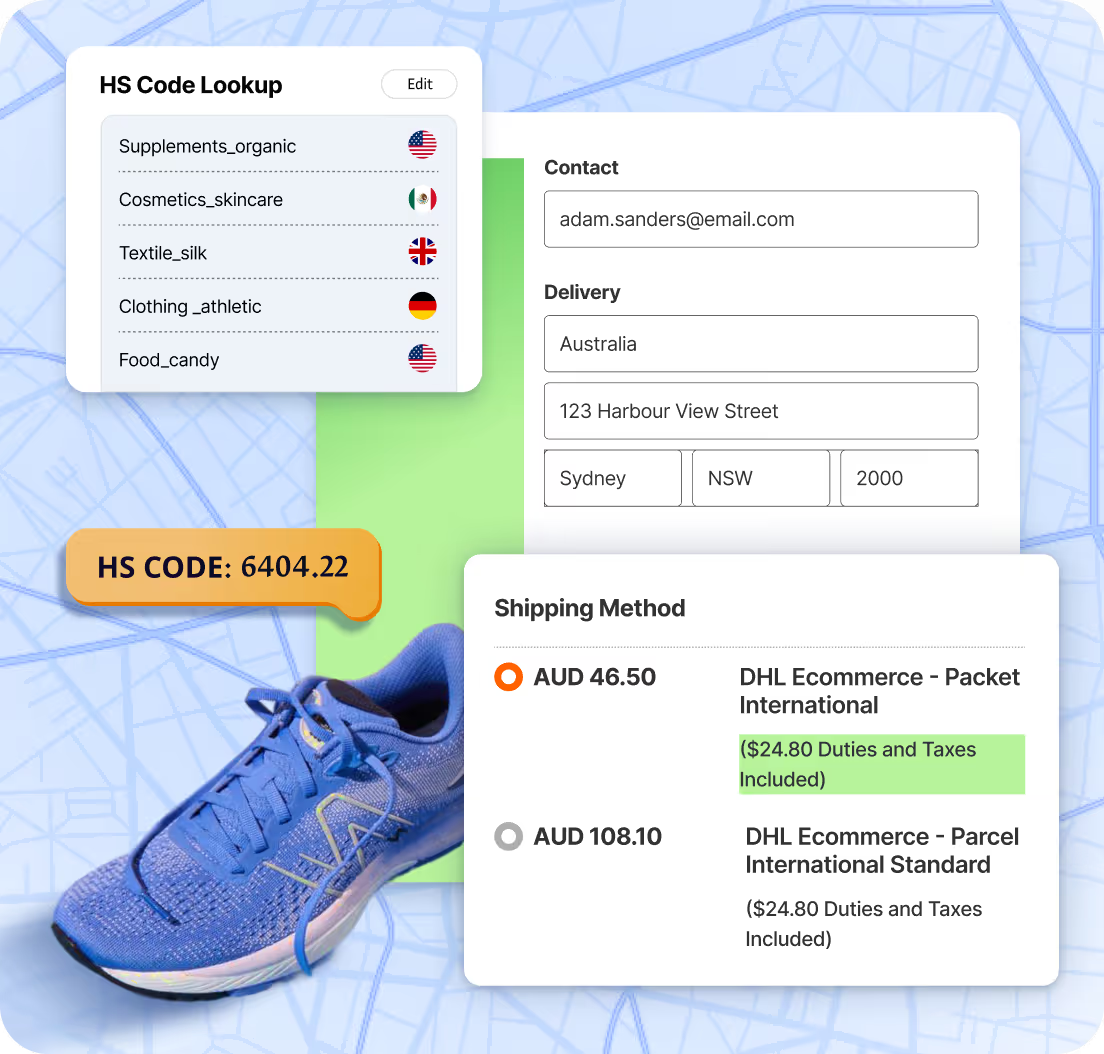
International Duties & Tariffs Ecommerce
Beyond VAT and GST, brands must manage:
HS code classification
Country of origin verification
Trade agreement eligibility
Section 301 or other tariff exposure
International duties compliance documentation
Incorrect classification can:
Increase duty rates
Delay shipments
Trigger customs audits
Erode margin
Duties are not just a compliance issue. They are a margin issue.
International Product Compliance
International product compliance varies by region and product category.
Examples include:
CE marking in the EU
UKCA marking in the UK
Ingredient restrictions for cosmetics
Supplement labeling laws
Textile fiber labeling standards
Safety certification requirements
Failure to meet international product compliance standards can lead to:
Shipment seizure
Product recall
Platform delisting
Regulatory fines
.avif)
.avif)
International Trade Compliance Ecommerce
This includes:
Sanctions screening
Restricted party screening
Export controls
Country embargo checks
Trade compliance failures can create legal exposure beyond tax penalties.
International Compliance Operations
It requires:
Filing calendar management
VAT reconciliation
Returns tax adjustments
Tariff monitoring
Regulatory updates tracking
Multi-channel alignment
Compliance is not:
A one-time registration
A static spreadsheet
An outsourced filing service
Without a structured international compliance operations model, complexity becomes unmanageable.
.avif)
Common international compliance mistakes
Expanding before VAT registration
Using incorrect HS codes
Assuming marketplaces cover all tax obligations
Ignoring tariff exposure
No centralized oversight
Not modeling compliance into CAC
No defined international compliance architecture
Treating compliance as an accounting function instead of operational infrastructure
The true cost of international compliance mistakes
International compliance costs fall into two categories.
Direct Costs
VAT back payments
Penalties
Legal fees
Customs broker corrections
Product re-labeling
Indirect Costs
Shipment delays
Inventory holds
Working capital trapped in VAT
Margin erosion from tariff surprises
Lost marketplace access
International Compliance Platforms vs Software vs Outsourcing
Approach
Coverage
Risk
Scalability
DIY + Accountant
Limited
High
High
Regional Tax Firms
Tax Only
Medium
Moderate
Compliance Software
Calculation
Gaps
Moderate
OpenBorder
End-to-End Infrastructure
Low
High
What a scalable international compliance strategy looks like
A modern international compliance framework includes:
Compliance Architecture
Defined tax registrations
Clear country launch roadmap
Channel alignment
Compliance Operations Model
Centralized oversight
Automated rate calculation
Filing management
Compliance Scalability
Repeatable country expansion playbook
Pre-launch compliance checklist
Ongoing regulatory monitoring
Margin Integration
Tariff modeling
Duty forecasting
Checkout tax alignment
Compliance must support growth, not slow it down.
OpenBorder integrates in one unified cross-border infrastructure layer
Tax compliance
Duties optimization
Product compliance guidance
Trade compliance
Ongoing operational oversight
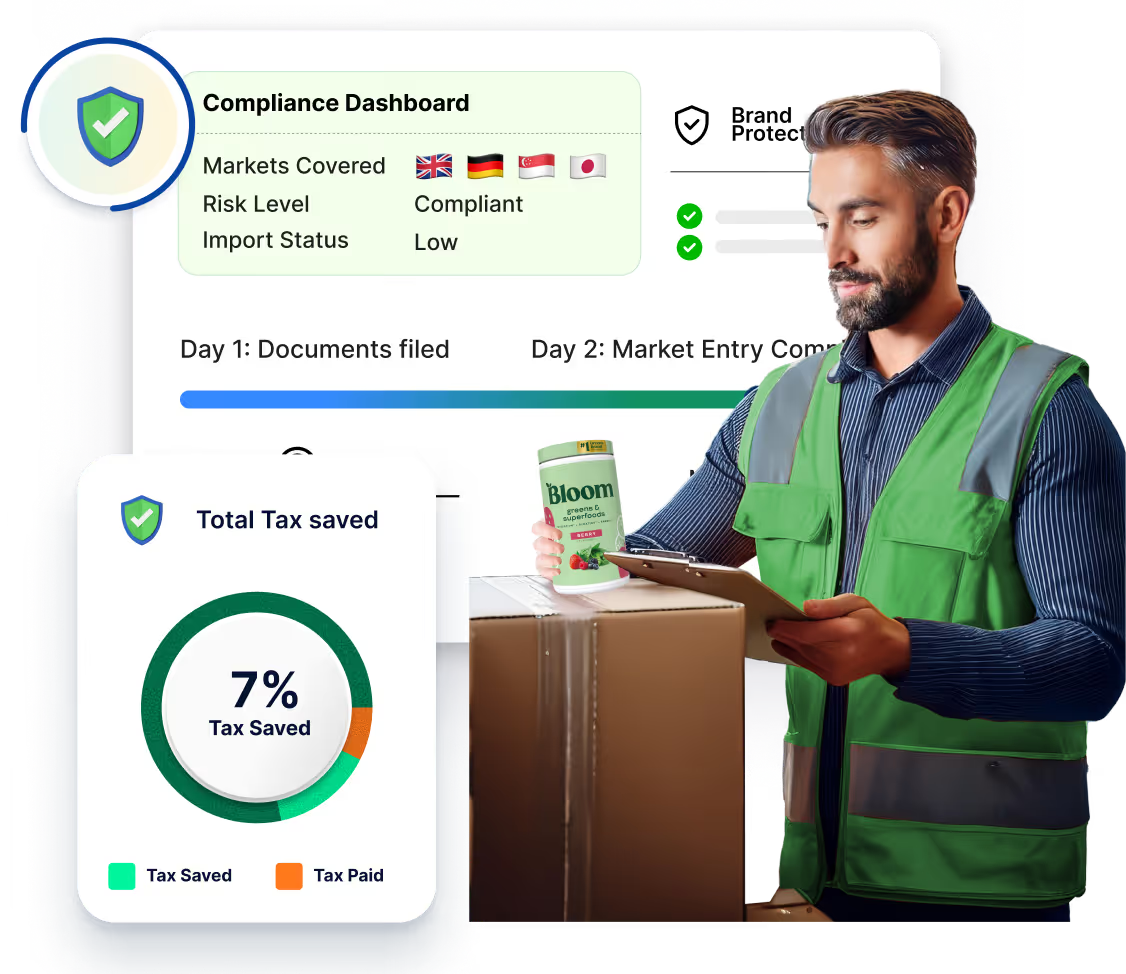
How OpenBorder solves international e-commerce compliance
OpenBorder was built specifically for brands scaling globally.
International Tax Compliance Management
VAT & GST registration coordination
Cross-border tax compliance filings
OSS/IOSS alignment
Marketplace tax oversight
International Duties & Tariff Modeling
HS classification support
Landed cost forecasting
DDP strategy design
International Product Compliance Support
Region-specific requirements guidance
Pre-launch compliance audits
International Trade Compliance
Sanctions screening
Restricted party checks
International Compliance Operations Infrastructure
Centralized oversight across markets
Multi-channel alignment (Amazon, Shopify, TikTok, distributors)
Ongoing regulatory monitoring
Scalable expansion framework
We provide international compliance infrastructure.
We don't provide fragmented compliance services.
International ecommerce compliance checklist
Before launching into a new country:
Tax compliance
Cross-border tax compliance filings
International duties compliance
International tariffs ecommerce classification
International product compliance requirements
International trade compliance ecommerce
Consumer protection and ecommerce regulatory requirements
Country-specific ecommerce laws
.avif)
Who OpenBorder supports
We work with brands that:
Generate $10M–$500M+
Expanding into EU, UK, Canada, Australia
Want predictable margin in new markets
Sell across multiple channels
Need international compliance scalability
International compliance becomes exponentially harder as you scale. We structure it before it breaks.
Frequently asked questions
1. EU VAT ecommerce registration
2. Do I need VAT registration to sell into the EU?
3. What is cross-border tax compliance?
4. What are international compliance risks?
5. Can compliance be automated?
Build Internationally Without Compliance Risk
International ecommerce compliance doesn't have to be fragmented, reactive, or stressful.
With the right infrastructure, you can:
With the right infrastructure, you can:
