Blogs
How to Increase Ecommerce Conversion: What Enterprise Brands Do Differently




Most ecommerce teams still approach international expansion as a linear rollout — launch first, analyze later. They commit budgets to localization, warehousing, and tax setup before knowing if a market will actually convert.
According to McKinsey’s Five Traps to Avoid in DTC E-Commerce, many brands see their early expansion efforts stall because demand and pricing strategy weren’t validated before launch.
Common pain points include:
A data-driven testing model changes that. Running lightweight experiments — on creative, pricing, or messaging — lets brands collect signals within weeks, not quarters, and base expansion decisions on proof, not projection.
At its very core, market validation is the process of confirming real buyer intent before committing full resources to a new country.
Instead of launching first and measuring later, teams gather behavioral data — click-throughs, add-to-cart rates, and purchases — to understand which markets show true traction.
Experimentation applies the same discipline as conversion optimization to global expansion.
Brands can simulate a market entry using small-scale tests that mimic local experiences: localized landing pages, currency visibility, translated copy, or pricing variations.
Key principle: Gather statistically relevant performance data before infrastructure investment.
The benefit is speed. Controlled digital tests generate directional results within days or weeks.
McKinsey & Company reports that more than 50% of companies whose revenue growth is in the top 10% are more effective than their peers at testing ideas, measuring results, and executing changes.
Effective validation frameworks use a three-stage cycle:
This approach ensures international growth decisions are evidence-based, not assumption-based.
Nope, A/B testing isn’t just limited to creative or landing pages. It’s a framework for learning which international markets will perform before you scale.
Run paid ads in multiple markets using the same creative and funnel structure. Compare click-through rate (CTR), conversion rate (CVR), and customer acquisition cost (CAC).
This isolates market interest — not creative performance. According to Google’s Think with Data, brands that run controlled multi-market tests reduce decision cycles by up to 60%.
Translate only high-impact parts of your site — currency, checkout, and messaging. Measure bounce rate and checkout completion per market variant.
Research from Stripe found that businesses offering local payment methods—and presenting prices in local currency—experienced an average 7.4% increase in conversion rate and 12% increase in revenue.
Use tools like OpenBorder to test price sensitivity by region and improve international gross profit.
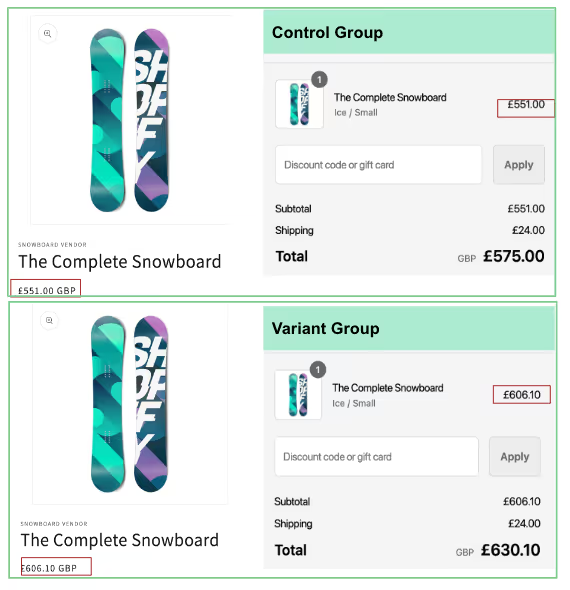
You can reduce LTV-CAC by 15% through A/B test on local currency prices recommended by OpenBorder based on your international growth goal.
Each of these tests builds the same foundation: data that clarifies where to expand, how to localize, and what drives intent before heavy operational lift.
Experimentation produces data — but the goal is clarity, not complexity. Each test should answer a single question: Is this market worth scaling?
The metrics that matter most during validation aren’t LTV or margin yet — they’re signal metrics that reveal potential:
If these metrics outperform your home-market benchmarks by 10–20 %, the market likely has scalable potential.
High engagement doesn’t always mean long-term profitability. Use small cohorts — 500–1,000 customers or site sessions — to validate demand.
Then, apply a scaling test (increasing budget or audience by 2–3× to see if results hold.
If CAC stays stable and conversion doesn’t drop, you’ve found a market worth deeper investment.
This simple progression keeps global growth structured:
Google’s Test and Learn Framework recommends running multiple concurrent tests across 2–3 markets to compare readiness rather than testing one country at a time (Think with Google, 2024). This accelerates learning cycles and minimizes wasted budget.
Before scaling, brands should build a repeatable decision model that includes:
This turns international expansion from a gamble into a quantifiable, repeatable process — one that leadership can defend with data.
What OpenBorder Enables
How It Works
Seamless Transition from Testing to Fulfillment
Move directly from A/B-tested demand to operational rollout. Use existing U.S. or U.K. inventory to go live—no need to set up local entities or warehouses.
Automated Compliance & Landed Cost Accuracy
AI-driven tax and duty engine auto-classifies products and calculates duties upfront, ensuring customers see the full landed cost at checkout.
Localized Checkout & Customer Experience
Support for local currencies, payments, and duty-inclusive pricing—maintaining consistency from test campaign to scale.
Unified Visibility Across Teams
One dashboard for marketing and ops teams—tracking conversion, customs status, delivery SLAs, and returns performance by market.
Result:
Brands move from insight to scale without losing speed or visibility. When the data says go, OpenBorder makes it operationally real in weeks—not quarters.